

Visualizing the incredible career of Juan Gabriel through data
This is part two of a three-part series that walks you through my recently built dashboard. Title of the dashboard is called: Juan Gabriel-Emotion, Sound, and Legacy. This visualization takes a deep tour in the career of Mexican idol Juan Gabriel analyzing his career and song portfolio. Throughout this project, I not only learned about the genius of ‘JuanGa’; I was able to peel the layers of the surface to fully understand how his music resonates with listeners for more than five decades.
Below is the breakdown of the three-part series:
- Dashboard design:
- Visualizing your template and crafting your story
- Scatterplots:
- Focusing on song mood and assessing song quality
- Viz Extensions & Embedded Web Objects:
- Linking vizzes together to build an overall picture
If you’re new to Juan Gabriel, you’re about to discover an artist whose music may quickly earn a place in your favorites.
Born Alberto Aguilera Valadez in Michoacán, Mexico, Juan Gabriel overcame early hardship after relocating to Ciudad Juárez, where his creativity, resilience, and hope for a future took shape. From a young age, he was writing songs, later becoming known for his rare ability to blend vulnerability and emotion into unforgettable performances.
As a Mexican-American with family roots in Juárez, this project is deeply personal. Juan Gabriel’s music was a constant in my home growing up, and the Netflix documentary Juan Gabriel: I Must, I Can, I Will further inspired me to explore his genius through data.
What truly set Juan Gabriel apart was his extraordinary ability to convey deep emotion through music that was often upbeat and high-energy. While high-tempo songs are typically associated with celebration, he infused them with vulnerability, longing, and emotional weight. This contrast—joy in rhythm, pain in expression—became his signature and allowed his music to resonate across generations. More than five decades later, those songs still connect because they reflect emotions that are timeless and deeply human.
Let’s chat about song features
If you’re like me, you probably have a Spotify account. What many people don’t realize is that Spotify provides access to data behind the songs you love—allowing you to explore music beyond the surface level of what you hear. In addition to offering one of the largest music catalogs available, Spotify exposes detailed audio features such as energy, positivity, tempo, and popularity.
For this dashboard, I used Musicstax.com to access audio feature data for Juan Gabriel’s studio albums, pulling metrics like energy, tempo, positivity, and popularity across his catalog. While this data was sourced through a third-party platform, the same information is available directly through Spotify’s API.
1. Popularity
- How well-known or streamed each song is.
- Shows which songs resonated most commercially.
2. Energy
- Measures intensity and activity (high tempo, strong instrumentation, vocal delivery).
- Great for visualizing upbeat vs. mellow songs.
3. Tempo (BPM)
- Beats per minute; shows the pacing of songs.
- Useful for connecting emotion to song speed (e.g., heartbreak in high-tempo tracks).
4. Key / Mode
- Musical key and whether it’s major or minor.
- Can illustrate how Juan Gabriel used major keys (joy) vs minor (melancholy) to convey complex emotions.
5. Valence / Positiveness
- Measures how happy or positive a song feels.
- Helps analyze how high-tempo songs can carry emotional depth despite “happy” keys.
6. Danceability
- How rhythmic and easy to move to the song is.
- Connects to why audiences loved his energetic performances.
7. Acousticness / Instrumentation
- Amount of acoustic vs. electronic/produced sound.
- Shows evolution of sound across decades.
8. Loudness / Dynamics
- Overall volume or intensity variations.
- Highlights dramatic expression in songs.
Assessing Song Moods in Juan Gabriel’s Discography
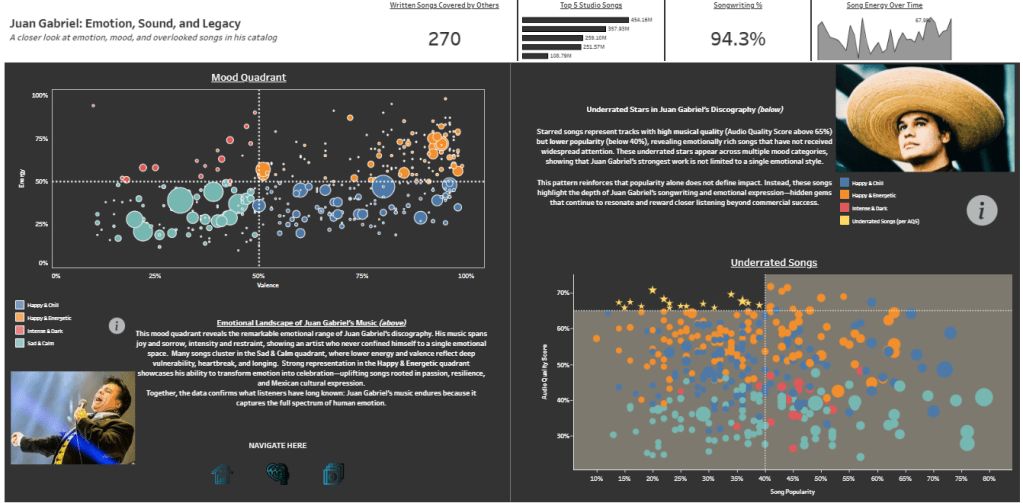
Using a scatter-plot I took a look at all songs from Juan Gabriel’s album, by plotting based on the audio features Valence and Energy. In doing this we create a ‘mood quadrant’ which plots his music across various moods. In the more refined photo below you can see the mood quadrant closely.
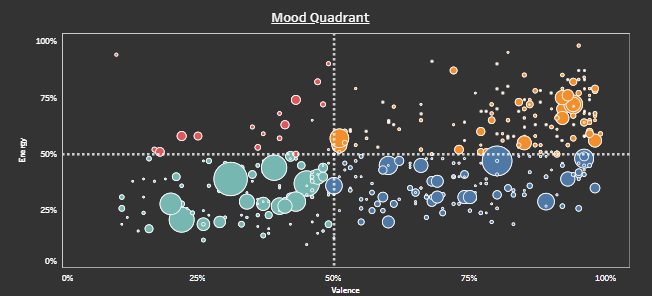
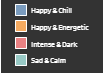
Each point represents a studio song, plotted by valence and energy. The quadrants serve as guides, with mood indicated by color and size reflecting Spotify plays. Right away, you can see that Juan Gabriel’s work centers around themes of happiness and sadness. His remarkable career stems from a unique ability to convey deep emotion through high-tempo songs, channeling personal challenges and experiences into authentic performances that explore heartbreak, love, grief, and joy.
Audio Quality Score:
Uncovering Hidden Gems
By leveraging most of the audio features, I created a Tableau calculation to generate an Audio Quality Score. This metric combines energy, danceability, loudness, valence, and other features to reflect overall production quality and listener appeal. Plotting Audio Quality Score against Popularity allows us to identify songs that may not have received widespread attention but still demonstrate strong audio quality.
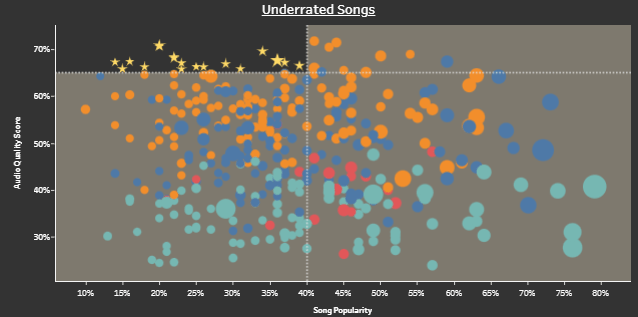
In the scatterplot above, the songs highlighted with star shapes stand out. These tracks have a popularity below 40% but an Audio Quality Score of 65% or higher.
This exercise uncovers hidden gems—songs that share the same strong audio characteristics as Juan Gabriel’s hits but haven’t reached the same level of listener recognition. Using the reference line features that you can apply to scatterplot visuals; I was able to shade areas of the viz to clearly show those marks that are considered ‘underrated’. In the photo above, the area shaded darker spotlights those songs that have been overlooked by other recognized songs.
Closing Thoughts
Juan Gabriel’s songs span a wide range of moods, from sad and calm ballads that tug at the heart to happy and energetic tracks that get listeners moving.
He also created moments that are happy and chill, capturing joy in a more relaxed, reflective way. This diversity of emotional expression helped his music resonate with listeners across generations. By blending tempo, energy, and valence, he could convey complex feelings in ways that feel both personal and universal.
His music didn’t just connect emotionally—it became part of life’s soundtrack for millions, accompanying weddings, family gatherings, and personal milestones across decades. The emotional authenticity in his songs, whether joyful or heartbreaking, helped break cultural norms around male vulnerability in music and gave voice to feelings many listeners had never seen expressed so openly.
 Ralph's Data World